
Equity benchmarks continued their winning momentum for the third day on Thursday and jumped over 1.50 per cent, tracking an overall bullish trend in Asian equities. On the political front, the BJP headed for a second straight win in politically crucial Uttar Pradesh and dominated the trends chart in three other states. The 30-share BSE benchmark Sensex opened in the green and further zoomed 1,595.14 points or 2.91 per cent to 56,242.47 during early trade.

Benchmark indices Sensex and Nifty gave up early gains to close lower for a fourth straight session on Thursday due to selling in IT and banking shares amid weak global equities. The 30-share BSE benchmark settled 98 points or 0.18 per cent lower at 53,416.15. During the day, it hit a high of 53,861.28 and a low of 53,163.77. The broader NSE Nifty also pared initial gains and ended 28 points or 0.18 per cent down to settle at 15,938.65.

Top gainers in the Sensex pack included Bharti Airtel, Tata Motors, IndusInd Bank, Kotak Bank, Hero MotoCorp, Asian Paints and PowerGrid, which rose up to 2.53 per cent.

At an aggregate level, the late ace investor's portfolio that was valued at Rs 32,445 crore as on March 31, 2023 is now worth Rs 35,979 crore.

India's total value of defence production breached Rs 1 trillion-mark in the fiscal year 2022-23 (FY23), up 12 per cent year-on-year (YoY). At the bourses, this has been well reflected in related-stocks from the sector as they gained considerable ground during this period. Shares of Hindustan Aeronautics (HAL), Mazagon Dock Shipbuilders, MTAR Technologies, Bharat Electronics (BEL), and Bharat Dynamics (BDL) have skyrocketed up to 160 per cent in a year, as against a 14 per cent jump in the S&P BSE Sensex.

The Indian financial services space seems to be in a sweet spot as foreign investors have made a net investment of Rs 14,205 crore ($2.1 billion) in the sector in November amid strong credit growth and manageable non-performing loan portfolio. The investment comes following a net withdrawal of Rs 4,686 crore from financial services stocks in October on account of profit booking. Overall, foreign portfolio investors (FPIs) have made a net investment of Rs 36,238 crore in the country's equity markets in November.

The sharp correction in equity markets has taken a toll on mid-and-small cap stocks that have underperformed their large-cap peers. Thus far in calendar year 2022 (CY22), the mid-and-small cap indexes on the BSE have slipped over 8 per cent and 7 per cent respectively, as compared to a fall of around 6 per cent in the S&P BSE Sensex. While investors dumped mid-and small-cap stocks as the markets remained choppy over the past few weeks, analysts still expect these two segments to see good investor interest from a medium-to-long term perspective.

The 30-share BSE gauge climbed 465.14 points or 0.80 per cent to finish at 58,853.07. During the day, it jumped 546.97 points or 0.93 per cent to 58,934.90.

Macroeconomic data announcement, Omicron situation and global trends will be the major driving factors for the equity market in the first week of the new year 2022, according to analysts. In what turned out to be a historic year, the Indian stock indices went past multiple milestones and the 30-share Sensex made an annual gain of 10,502.49 points or 21.99 per cent in 2021. Religare Broking Vice-President (Research) Ajit Mishra said, "This week marks the beginning of a new month and participants will be closely eyeing some crucial high-frequency data like monthly auto sales, India manufacturing PMI and India services PMI. "Besides, updates on the COVID-19 situation and performance of global markets will also be critical."

Benchmark indices finished on a weak note on Thursday, extending their previous day's decline amid a negative trend in global equity markets after the US Fed hiked interest rates by 75 basis points. The 30-share BSE Sensex declined 69.68 points or 0.11 per cent to settle at 60,836.41. During the day, it tanked 420.95 points or 0.69 per cent to 60,485.14.

Contributions to mutual fund schemes through systematic investment plans or SIPs remain unfazed from the market volatility in 2022 with inflow growing to Rs 1.5 lakh crore in 2022, a surge of 31 per cent from a year earlier, due to higher retail participation. In comparison, an inflow of Rs 1.14 lakh crore through the route was registered in 2021 and Rs 97,000 crore in 2020, data with the Association of Mutual Funds in India (AMFI) showed. Going ahead, SIP numbers are expected to continue to remain strong in 2023 as investors are increasingly appreciating the importance of regular investing through the route, Kaustubh Belapurkar, director - manager research at Morningstar Investment Adviser India, said.
Investors became poorer by over Rs 4.47 lakh crore on Friday as markets faced severe drubbing, mirroring weak trends in global equities. The 30-share BSE benchmark dived 866.65 points or 1.56 per cent to settle at 54,835.58. During the day, it tumbled 1,115.48 points or 2 per cent to 54,586.75.

Investors' wealth on Tuesday jumped by over Rs 2.51 lakh crore, in tandem with a sharp recovery in equities after four days of heavy declines. The 30-share BSE Sensex opened on a weak note and tumbled 581.93 points or 1.10 per cent to 52,260.82 during the day amid firming oil prices and relentless selling by foreign institutional investors. Amid bouts of volatility, the benchmark touched a high of 53,484.26 and a low of 52,260.82 during the trade. It finally settled at 53,424.09, higher by 581.34 points or 1.10 per cent.

Equity benchmarks Sensex and Nifty on Thursday gave up all early gains to settle lower as surging oil prices amid the ongoing conflict between Russia and Ukraine hit investor sentiment. The 30-share BSE Sensex started the trade on a higher note and jumped 527.72 points in morning deals to a high of 55,996.62. However, during the afternoon trade it surrendered all its early gains and finished at 55,102.68, lower by 366.22 points or 0.66 per cent.

The National Stock Exchange (NSE) Nifty Next 50 Index could undergo large-scale changes if the proposed tweaks to its computation methodology get implemented. In a discussion paper floated recently, NSE Indices, which owns and manages a portfolio of over 350 indices under the Nifty brand, proposed that only stocks that are traded in the futures and options (F&O) segment can be part of the index. Currently, as many as 11 non-F&O stocks are part of the Nifty Next 50 Index, which, as the name suggests, represents the next rung of large and liquid securities after the Nifty50.

The rupee plunged 58 paise to close at an all-time low of 81.67 (provisional) against the US dollar on Monday as the strengthening of the American currency overseas and risk-averse sentiment among investors weighed on the local unit. Moreover, escalation of geopolitical risks due to conflict in Ukraine, a negative trend in domestic equities and significant foreign fund outflows sapped investor appetite, forex traders said. At the interbank foreign exchange market, the local currency opened at 81.47, then fell further to close at an all-time low of 81.67 against the American currency, registering a decline of 58 paise over its previous close.

Benchmark stock indices rebounded around 1 per cent on Thursday following value buying in banking, IT and auto stocks after two days of losses and a largely positive trend in global markets. The 30-share BSE Sensex climbed 659.31 points or 1.12 per cent to settle at 59,688.22. During the day, it jumped 683.05 points or 1.15 per cent to 59,711.96. The broader NSE Nifty rose by 174.35 points or 0.99 per cent to close at 17,798.75.

Equity benchmarks had another rough day on Monday, with the Sensex plummeting 1,457 points and the Nifty tumbling to the 15,774 level, mirroring an extremely weak trend in global markets along with unrelenting foreign fund outflows. Index majors ICICI Bank, Infosys and Reliance Industries bore the brunt of heavy selling. The 30-share BSE Sensex tumbled 1,456.74 points or 2.68 per cent to settle at 52,846.70.

The mutual fund (MF) industry has seen a fair number of new entrants in the last 10 years but none of them have proved to be much of a challenge for the larger players. The list of top 20 fund houses, which manage over 90 per cent of the industry's total assets, continues to be dominated by players who have been in the business for more than a decade. Bajaj Finserv MF may change that, say experts.

The BSE gauge Sensex fell 73.88 points to 35,548.26 and the NSE Nifty slid 17.85 points to 10,799.85, taking cues from tumbling global shares.
Benchmark equity indices Sensex and Nifty closed higher by more than half a per cent on Wednesday following buying in IT, financial and oil stocks after the RBI slowed down the pace of interest rate hikes. Ending its two-day slide, the 30-share BSE Sensex rebounded by 377.75 points or 0.63 per cent to close at 60,663.79 with 24 of its constituents posting gains. The broader Nifty of the NSE spurted by 150.20 points or 0.85 per cent to settle at 17,871.70, riding on a rally in Adani Enterprises, Adani Ports and HDFC Life.

Investors are increasingly turning optimistic about shares of new-age companies. From broad-based 'sell' calls, analysts are giving thumbs up to Zomato, Paytm, and FSN e-Commerce Ventures-owned Nykaa as these companies have shifted focus to sustainable profits. The shares of Zomato hit a fresh 52-week high of Rs 126 apiece on the BSE on November 7, having rallied 15.4 per cent in one week.

Benchmark indices bounced back on Wednesday after a two-day decline, with the Sensex and Nifty climbing nearly 1 per cent each, tracking a positive trend in European markets. Buying in IT and bank stocks also supported the recovery in equities. The 30-share BSE benchmark jumped 547.83 points or 0.99 per cent to settle at 55,816.32.

Equity benchmarks eked out marginal gains to settle in the positive zone after swinging between gains and losses during the session on Wednesday amid weakness in global bourses. In a trade marked with highs and lows, the 30-share BSE Sensex climbed 54.13 points or 0.09 per cent to settle at 59,085.43. During the day, it hit a high of 59,170.87 and a low of 58,760.09. Similarly, the broader NSE Nifty went up by 27.45 points or 0.16 per cent to 17,604.95.

Bajaj Finance was the top loser in the Sensex pack, tanking over 10 per cent, followed by Axis Bank, Maruti, M&M, Tech Mahindra and ONGC. The gainers included ITC, Bharti Airtel, Kotak Bank and Hero MotoCorp.

ICICI Bank was the top laggard in the Sensex pack, cracking over 5 per cent, followed by Kotak Bank, HUL, HDFC, IndusInd Bank, HDFC Bank and Nestle India. On the other hand, Hero MotoCorp, Bajaj Auto, Maruti, TCS and HCL Tech were among the gainers.

Benchmark indices Sensex and Nifty gave up early gains to close in negative territory on Thursday dragged down by IT and pharma stocks which fell amid fears of recession in the global economy. The 30-share Sensex opened higher and rose further to touch a day's high of 60,676.12 on gains in auto and capital goods shares. However, it gave up all early gains and later closed 412.96 points or 0.68 per cent lower at 59,934.01.

'The news about the new virus strain in the UK provided them with an opportunity to take money off the table.'
PowerGrid was the top loser in the Sensex pack, shedding over 4 per cent, followed by Reliance Industries, Asian Paints, Kotak Bank, Tech Mahindra and Bharti Airtel. NSE Nifty tanked 204.95 points to 17,196.70.

Equity indices overcame a wobbly start to clock gains for the third session on the trot on Tuesday, propped up by banking, metal and energy stocks amid a mixed trend in global markets. A recovery in the rupee also bolstered sentiment, traders said. The 30-share BSE Sensex advanced 246.47 points or 0.45 per cent to settle at 54,767.62 after starting the trade on a weak note. In a volatile session, the benchmark hit a high of 54,817.52 and a low of 54,232.82 during the day.

The market capitalisation of BSE-listed companies jumped to a record high of Rs 2,40,04,664.28 crore on Tuesday, driven by a rally in stocks that also saw the benchmark Sensex touching its lifetime peak of 53,887.98 points. Rallying for the second consecutive day on Tuesday, the 30-share BSE index closed at a fresh closing peak of 53,823.36 points, a jump of 872.73 points or 1.65 per cent. During the day, it zoomed 937.35 points to 53,887.98 points.
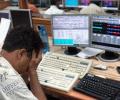
Titan, Maruti Suzuki India, Asian Paints, Mahindra & Mahindra and Hindustan Unilever Limited were the biggest drags on the Sensex, tumbling up to 5.05 per cent. In contrast, ITC, Dr Reddy's Laboratories, Tech Mahindra and UltraTech Cement were among the gainers.

All Sensex components ended in the red. IndusInd Bank was the top loser, followed by Tata Steel, HDFC, ICICI Bank, Axis Bank, Infosys and ITC. According to traders, volatility heightened in global markets as US Federal Reserve's interest rate cut stoked concerns over an impending economic recession.

Higher growth justifies current run-up, say experts.
Tech Mahindra was the top laggard in the Sensex pack, cracking over 5 per cent, followed by Infosys, HDFC, IndusInd Bank, Reliance Industries and NTPC. On the other hand, Hero MotoCorp, L&T, Maruti, UltraTech Cement and Sun Pharma led the gainers' chart.

The mid-and small-cap segments at the bourses have outperformed their larger peers thus far in fiscal 2023-24 (FY24). While the S&P BSE Small-cap index has surged around 5.7 per cent in FY24, the S&P BSE Midcap index has gained 4 per cent during this period. In comparison, the S&P BSE Sensex has moved up around 2.2 per cent.
ICICI Bank was the top laggard in the Sensex pack, sinking over 10 per cent, followed by Bajaj Finance, HDFC, IndusInd Bank, Axis Bank and Maruti. Bharti Airtel and Sun Pharma were the gainers in the BSE index. NSE Nifty suffered a heavy loss of 566.40 points, or 5.74 per cent, to settle at 9,293.50.

Equity investors grew richer by Rs 32.49 lakh crore in 2020 on the back of smart returns in the stock market which had a roller-coaster ride during the year hit by the coronavirus pandemic. The COVID-19 outbreak ravaged lives and livelihoods on a global scale, shuttering businesses and jolting world equities. But amid all the gloom, Indian stock indices gave hope of returning to winning ways towards the latter part of the year.

As markets complete the first half of the calendar year 2022 (CY22) with a fall of around 9 per cent, the interest-rate hike trajectory by global central banks, paired with the conundrum of inflation and growth, will move the needle for the market, observe experts. Here's a quick rundown on what they'll react to over the next six months.

'Just the amount of work which is there just to become more and more successful in banking. For this to happen you need to have leaders who understand technology.'
